Artificial intelligence can sometimes seem complicated. We use AI when a chatbot answers a question, a streaming platform recommends a movie, a phone recognizes a face, or an app predicts what we might type next.
But how does AI actually learn?
The four steps in the AI learning journey provide a simple way to understand the basic process:
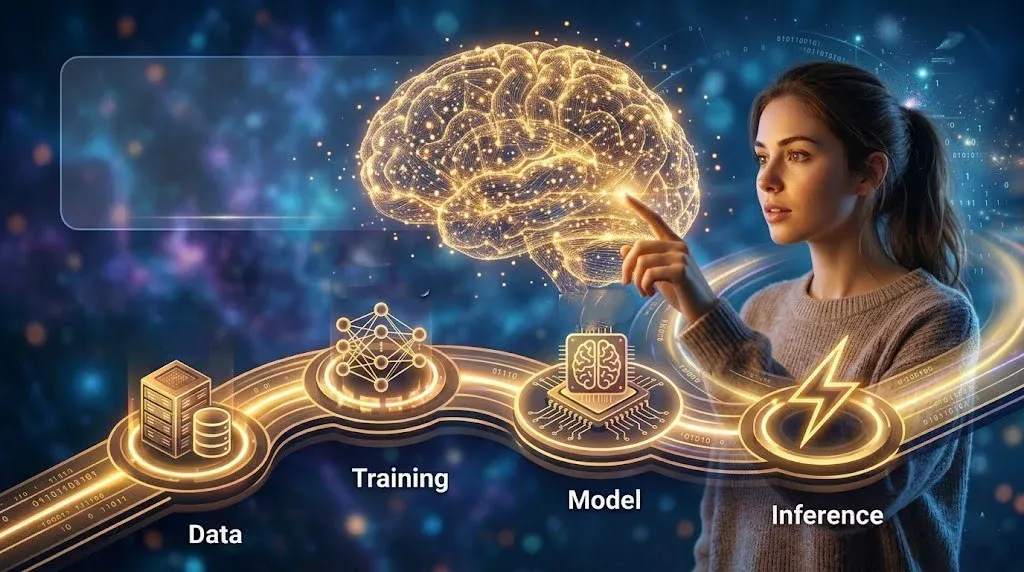
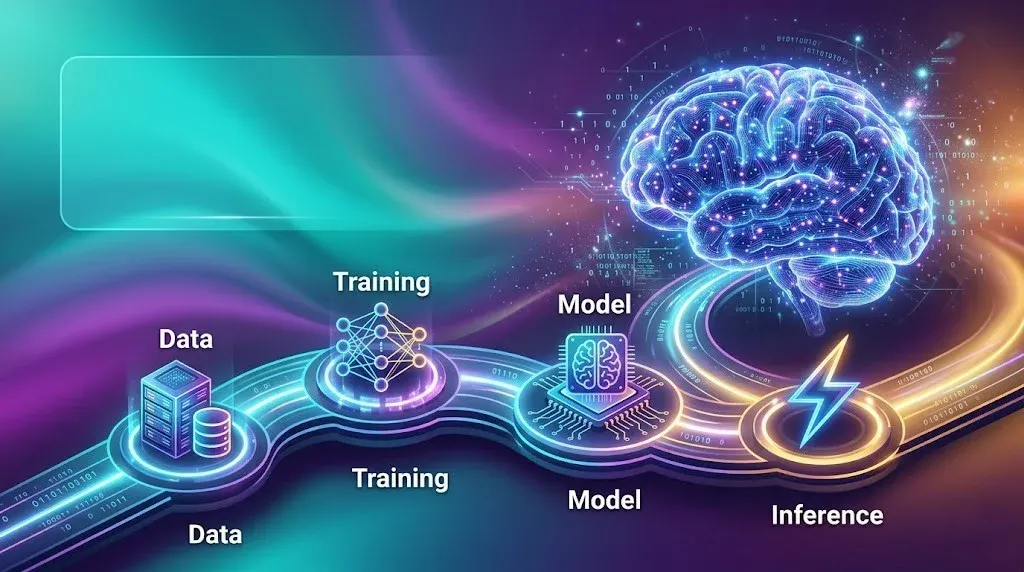
Data → Training → Model → Inference
These four stages explain how information becomes a trained AI system and how that system eventually produces useful results.
Whether you are a complete beginner, a student, a digital marketer, or someone learning AI tools, understanding these four steps gives you a strong foundation for learning artificial intelligence.
What Are the Four Steps in the AI Learning Journey?
The four main steps are:
- Data
- Training
- Model
- Inference
Each step has a different purpose, but together they form the basic AI learning process.
Let’s understand each stage with simple examples.
Step 1: Data – The Information AI Learns From
Data is the starting point of an AI system.
An AI model needs information to identify patterns and learn how to perform a particular task. Depending on the application, that information can include text, images, audio, video, numbers, documents, or other digital information.
For example, an AI system designed to identify cats and dogs could be trained using thousands or millions of labeled images.
The images provide examples from which the system can learn.
What Happens During the Data Stage?
The data process can involve:
- Collecting relevant information
- Removing duplicate or incorrect data
- Organizing the information
- Labeling examples when necessary
- Checking data quality
- Separating data for training and evaluation
The quality of the data matters. Poor, incomplete, or heavily biased data can contribute to poor model performance.
Simple Example
Imagine you want to build an AI system that identifies spam emails.
You might provide examples such as:
Email A → Spam
Email B → Not Spam
Email C → Spam
Email D → Not Spam
The AI can use these examples to learn patterns associated with spam messages.
Step 2: Training – Teaching the AI to Recognize Patterns
Once the data is prepared, the next stage is training.
Training is the stage where a machine-learning algorithm uses examples to learn patterns in the data.
The model makes predictions, compares those predictions with the expected results, calculates errors, and adjusts its internal parameters. This process can happen repeatedly.
For modern neural networks, optimization methods adjust model parameters to reduce the training error.
Think of Training Like Practice
Imagine learning to play cricket.
You take a shot and miss.
You receive feedback, adjust your technique, and try again.
After many repetitions, your performance can improve.
AI training follows a comparable learning pattern:
Example → Prediction → Error → Adjustment → Repeat
The actual mathematics behind AI training can be extremely complex, but this basic idea is useful for beginners.
How Long Does Training Take?
Training time depends on many factors, including:
- Dataset size
- Model architecture
- Computing hardware
- Number of training iterations
- Complexity of the task
- Optimization techniques
A small machine-learning model may train relatively quickly, while very large AI models can require substantial computing infrastructure and extended training processes.
Step 3: Model – The Trained AI System
After training, the result is a model.
A trained model contains learned parameters that allow it to recognize patterns and produce outputs from new inputs.
Think of the model as the result of the learning process.
For example, after training an image-classification system on many labeled pictures, the resulting model may be able to estimate whether a new image belongs to a particular category.
What Does an AI Model Contain?
Depending on the type of AI system, a model can contain a large number of learned parameters.
These parameters represent patterns learned during training.
Different models can have very different:
- Sizes
- Architectures
- Capabilities
- Training requirements
- Accuracy levels
- Computational requirements
Some AI models can run directly on phones or other devices, while larger models may require powerful cloud infrastructure.
Training vs Model
This distinction is important:
Training is the process of learning.
Model is the trained system produced by that process.
A simple analogy is:
Studying = Training
Knowledge gained from studying = Model
Step 4: Inference – When the AI Uses What It Learned
The fourth stage is called inference.
Inference happens when a trained AI model receives new input and produces an output.
For example, when you enter a question into an AI chatbot, the system processes your input and generates a response using its trained model.
Other examples include:
- Image recognition
- Speech recognition
- Search suggestions
- Recommendation systems
- Fraud detection
- Text classification
- AI-powered assistants
A Simple Example
Suppose an AI image model has already been trained.
You provide a new image as input.
The model processes that image and produces a prediction or generated result.
That real-world use of the trained model is inference.
The Complete AI Learning Journey
The four stages can be summarized like this:
Data → Training → Model → Inference
Here is a simple table:
| Step | What Happens | Simple Example |
|---|---|---|
| Data | Information is collected and prepared | Thousands of labeled images |
| Training | AI learns patterns from examples | Model learns visual features |
| Model | Learned parameters are stored in a trained system | Trained image classifier |
| Inference | Model processes new input | Identifies a new image |
This sequence gives beginners a simple mental model for understanding how many AI systems are developed and used.
What Happens After Inference?
The four-step framework is useful, but real AI development often continues beyond inference.
AI systems can collect information about how they perform in practical settings. Depending on the system and its design, this information may be reviewed and used to improve future versions.
This creates a broader cycle:
Data → Training → Model → Inference → Evaluation/Feedback → Improved Data or Training
However, not every AI system automatically learns from every user interaction. Updating a model generally requires a deliberate development and evaluation process.
Why Is Data Quality Important for AI?
One of the most important lessons in AI is that data quality affects the learning process.
Suppose an AI system is trained using incomplete or unrepresentative examples.
The resulting model may perform poorly on situations that were not adequately represented in the training data.
Good datasets should be considered for:
- Accuracy
- Relevance
- Diversity
- Completeness
- Consistency
- Potential bias
- Appropriate labeling
This is why data preparation is an important part of AI development.
AI Learning Journey Example: Spam Detection
Let’s put all four stages together using a simple spam-email example.
Data
Collect many emails labeled as spam or legitimate.
Training
Use these examples to train a machine-learning model to recognize patterns.
Model
The trained system stores the learned parameters needed to classify new emails.
Inference
A new email arrives, and the model predicts whether it is likely to be spam.
The same basic idea can be applied to many other AI applications.
AI Learning Journey Example: Image Recognition
Consider an AI system designed to identify different types of plants.
Step 1 – Data
Collect a large set of plant images with appropriate labels.
Step 2 – Training
Train the model using those examples so it can learn relevant visual patterns.
Step 3 – Model
The trained model contains the learned parameters.
Step 4 – Inference
Give the model a new plant image, and it produces a prediction based on what it learned.
AI Learning Journey vs AI Development Process
It is important to understand that “four steps in the AI learning journey” can be described differently depending on the educational framework.
Some educational materials describe the AI learning cycle as Data → Training → Model → Inference, while other frameworks use stages such as design, development, testing, and deployment.
For the learning-journey framework discussed here, the four stages are:
Data → Training → Model → Inference.
This distinction helps avoid confusion when you encounter different four-step AI frameworks in courses or textbooks.
What Is the Difference Between AI, Machine Learning, and Deep Learning?
These terms are related but not identical.
Artificial Intelligence
AI is the broader field concerned with creating systems capable of performing tasks associated with aspects of intelligent behavior.
Machine Learning
Machine learning is a major approach within AI in which systems learn patterns from data rather than relying only on explicitly written rules.
Deep Learning
Deep learning is a subset of machine learning that uses neural networks with multiple layers.
A simple relationship is:
AI → Machine Learning → Deep Learning
Not every AI system uses deep learning.
Frequently Asked Questions
What are the four steps in the AI learning journey?
The four steps are Data, Training, Model, and Inference. Data provides the examples, training allows the system to learn patterns, the model stores the learned parameters, and inference is when the trained model processes new input.
What is the first step in the AI learning journey?
The first step is Data. AI systems need appropriate data to learn patterns for their intended task.
What happens during AI training?
During training, an AI system processes examples, produces predictions, measures errors, and adjusts its parameters to improve its performance.
What is an AI model?
An AI model is a trained computational system containing learned parameters that can be used to generate predictions, classifications, or other outputs from new inputs.
What does inference mean in AI?
Inference is the process of using a trained AI model on new input to produce an output, such as a prediction, classification, recommendation, or generated response.
Does AI automatically learn every time I use it?
Not necessarily. An AI system can perform inference without changing its underlying model. Model improvement usually requires a separate process involving evaluation, data collection, retraining, fine-tuning, or other development steps.
Why is data important in AI?
Data provides the examples from which machine-learning systems learn patterns. The quality, relevance, diversity, and representation of that data can affect how well a model performs.
Quick Cheat Sheet
Remember the four stages with this simple formula:
1. Data → Give AI information
2. Training → Teach AI to recognize patterns
3. Model → Save the learned system
4. Inference → Use the model on new input
Once you understand these four concepts, many AI terms become easier to understand.
Final Thoughts
The **four steps in the AI learning journey—Data, Training, Model, and Inference—**provide a simple framework for understanding how many machine-learning systems move from information to useful results.
AI begins with data. During training, algorithms learn patterns from that data. The learned parameters form a model, and inference allows that trained model to process new inputs.
Understanding this basic cycle is a useful starting point for anyone learning artificial intelligence, machine learning, generative AI, or AI tools.
The technology behind modern AI can be extremely sophisticated, but the fundamental journey can be remembered in four words:
Data → Training → Model → Inference.